

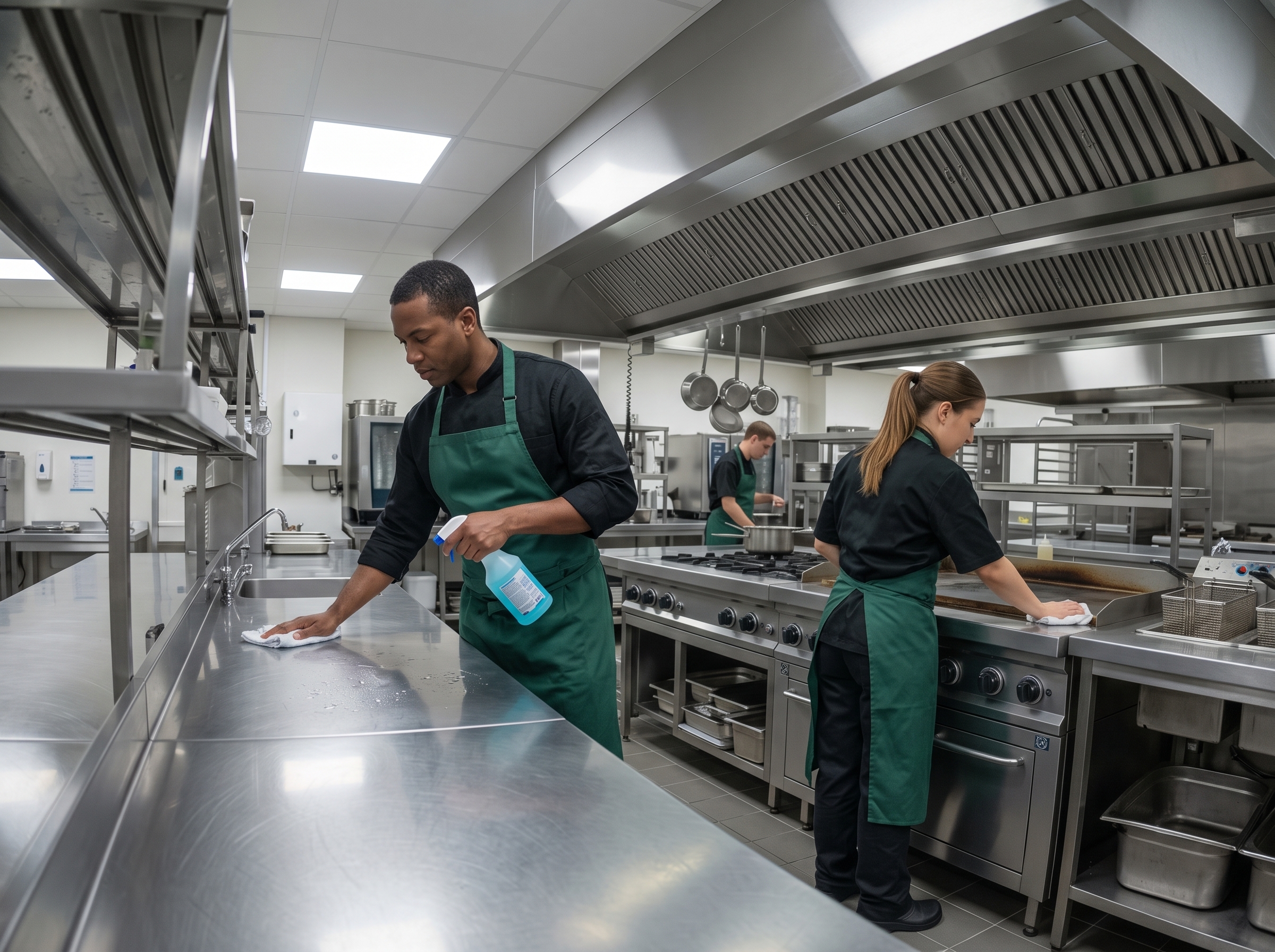
In a restaurant, customers may never see the kitchen—but they will notice when something feels unclean.
A sticky floor, stained chair, unpleasant smell or dirty restroom can quickly affect a customer’s impression of your restaurant. And behind the scenes, grease, food particles and dirt can accumulate in places that routine daily cleaning may not fully address.
That is why restaurants need periodic deep cleaning in addition to everyday cleaning.
Here’s a practical checklist.
- Start With the Kitchen
The kitchen deserves the most attention because this is where food, heat, grease and moisture constantly meet.
A proper deep clean should cover:
Floors, corners and hard-to-reach areas
Walls and tiled surfaces
Worktops and preparation areas
Exterior surfaces of cooking equipment
Areas underneath and behind movable appliances
Sinks and washing areas
Shelving and storage surfaces
Grease-prone areas
Daily wiping keeps a kitchen operational. Deep cleaning tackles the buildup that daily routines can leave behind.
- Don’t Forget the Dining Area
Your dining area is where customers form much of their impression of your restaurant.
Tables may be wiped constantly, but deep cleaning should go further.
Pay attention to chairs, underneath tables, corners, skirting areas, windows, doors, high-touch surfaces and difficult-to-reach sections of the floor.
If your restaurant has upholstered chairs or booths, these should also be cleaned periodically.
- Restrooms Need More Than a Quick Mop
A clean dining room can be completely undermined by a poorly maintained restroom.
During deep cleaning, focus on toilets, sinks, mirrors, doors, handles, walls, floors, corners and other high-touch areas.
Also pay attention to odours. A restroom can look clean and still create a poor impression if it doesn’t smell fresh.
- Check the Places Customers Don’t See
Some of the biggest cleaning problems develop away from public view.
Check:
Behind equipment. Under storage units. Around waste areas. Inside corners. Along walls. Around drains and other moisture-prone areas.
These spaces can gradually collect grease, crumbs, dust and other debris.
- Review Waste and Pest-Prone Areas
Restaurants naturally produce food waste, which means waste-handling areas need particular attention.
Bins and surrounding areas should be thoroughly cleaned, and signs of pest activity should never be ignored.
Where necessary, professional fumigation or pest-control treatment should form part of the restaurant’s hygiene plan rather than waiting until there is a visible infestation.
How Often Should a Restaurant Be Deep Cleaned?
There is no single schedule that works for every restaurant.
A busy restaurant with heavy kitchen activity may require deep cleaning more frequently than a smaller operation.
The better approach is to combine:
Daily cleaning → regular detailed cleaning → scheduled professional deep cleaning.
The objective is to prevent dirt and grease from reaching the point where they become difficult to manage.
Where Prestine Comes In
Your restaurant team already has enough to focus on—customers, food quality and service.
Prestine can handle the deeper cleaning work that falls outside the normal daily routine.
From restaurant deep cleaning and upholstery cleaning to fumigation and commercial cleaning, our team can help you maintain a cleaner, more presentable environment for both customers and staff.
Great food brings customers in. A clean environment helps bring them back.
Prestine Cleaning Company
Clean Spaces. Happy Faces.
Book a Prestine Cleaning Service
Call/WhatsApp Prestine: +234-916-149-2626
Instagram: @prestinee_hq
Website: www.prestinee.com


